
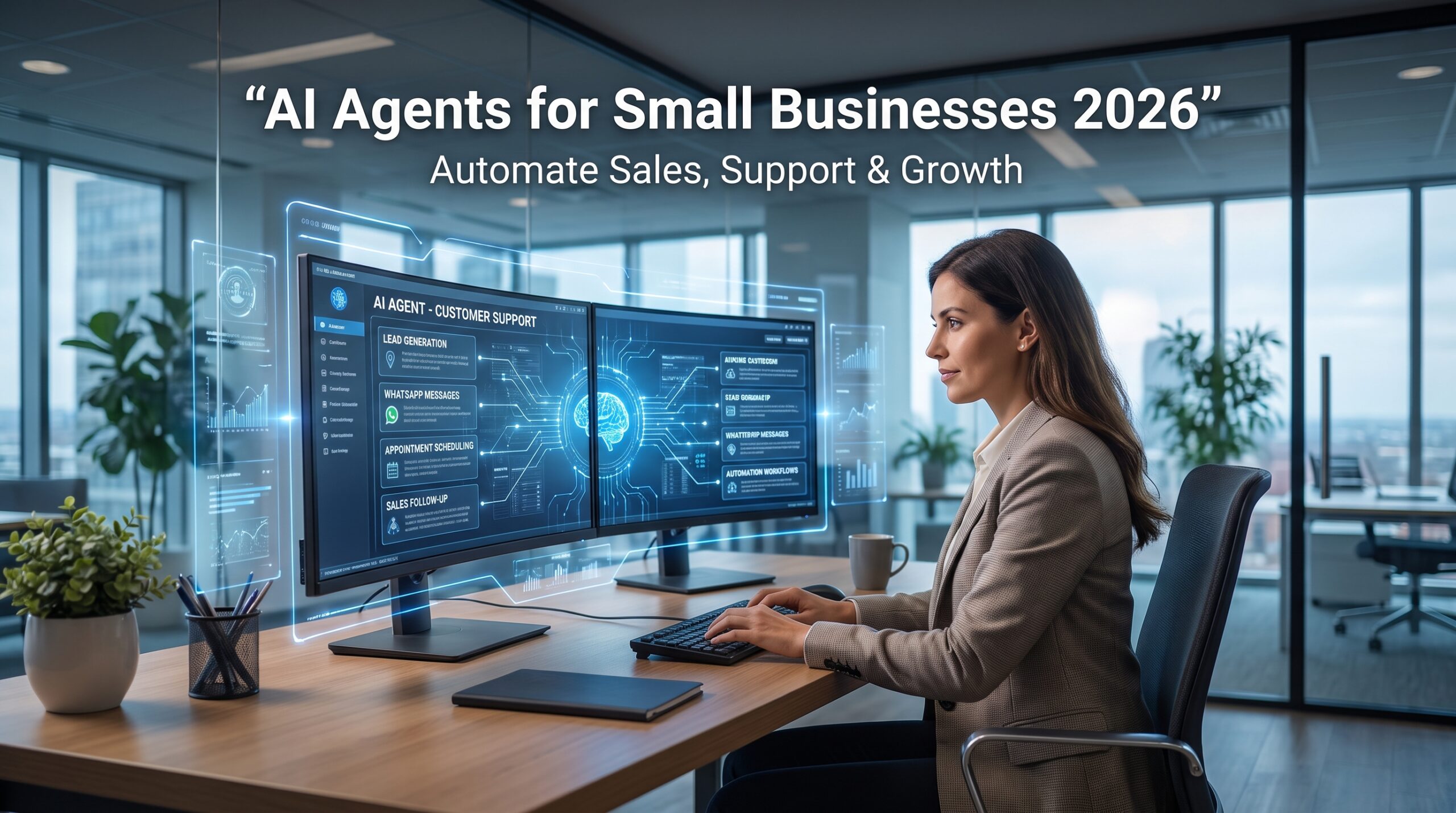
How to Build AI Agents for Small Businesses in 2026
AI is no longer something only large companies can afford or understand. In 2026, small businesses can use AI to handle customer questions, qualify leads, follow up with prospects, manage appointments, and complete repetitive tasks without building a huge technical team. AI Agents for Small Businesses
One of the most useful developments in this area is the rise of AI agents for small businesses.
Unlike a basic chatbot that simply responds to messages, an AI agent can be designed to understand a goal, make decisions based on rules, use connected tools, and take action.
For a small business owner, that can mean fewer repetitive tasks and more time spent on customers and growth.
In this guide, we will look at what AI agents are, how they work, practical use cases, how beginners can build them, what tools they need, how much they can cost, and how agencies can turn AI agent development into a service.
What Is an AI Agent?
An AI agent is a software system that uses artificial intelligence to complete a specific task or achieve a defined goal. AI Agents for Small Businesses
A traditional chatbot may answer:
“What are your business hours?”
An AI agent can go further. It might understand what the customer wants, check available information, collect their details, recommend the next step, update a CRM, and notify a team member.
The important difference is that an AI agent is built around action, not just conversation.
For example, a dental clinic could have an AI agent that:
- Answers common questions
- Collects patient information
- Checks appointment availability
- Helps customers choose a suitable time
- Sends appointment details
- Follows up with people who did not complete the booking
The exact capabilities depend on the tools and permissions connected to the agent.
AI Agents vs Chatbots vs Automation
These terms are often used interchangeably, but they are not exactly the same.
Chatbots
Chatbots mainly communicate with users. They are useful for FAQs, customer support, and simple conversations.
Automation
Automation follows predefined rules.
For example:
New form submission → send email → add contact to CRM → notify sales team
There does not necessarily need to be AI involved.
AI Agents
AI agents combine AI reasoning with workflows, tools, business rules, and actions.
For example:
Customer message → understand intent → qualify lead → check information → decide next step → update CRM → notify salesperson
That makes agents particularly interesting for businesses where every customer interaction is slightly different.
Why Small Businesses Are Interested in AI Agents in 2026
Small businesses often have a simple problem: there is plenty of work, but not enough time.
The owner may be answering WhatsApp messages, replying to emails, following up with leads, scheduling appointments, preparing reports, and dealing with customer questions at the same time.
AI agents can help reduce some of this repetitive workload.
Research and industry guidance around AI adoption increasingly focuses on practical business applications rather than AI being used simply as a novelty.
The key is not to automate everything.
The better approach is to identify repetitive processes where an AI agent can save time without creating unnecessary risk.
If you are new to business automation, our guide to AI automation services is a useful next step because it explains how businesses can turn repetitive processes into practical automated workflows.
7 Practical AI Agent Use Cases for Small Businesses
1. Lead Generation and Qualification
Lead qualification is one of the strongest use cases.
Instead of having a salesperson manually ask every new prospect the same questions, an AI agent can collect basic information first.
For example:
AI agent: What type of service are you looking for?
Customer: A new ecommerce website.
AI agent: Great. What platform are you currently using?
The agent can then collect information such as budget range, business type, required service, timeline, and contact details.
Qualified leads can then be sent to the sales team.
This does not replace the salesperson. It helps the salesperson spend more time with prospects who are actually interested.
2. Customer Support
Many small businesses receive the same questions repeatedly.
An AI agent can handle common questions about:
- Products
- Services
- Pricing
- Delivery
- Opening hours
- Policies
- Booking procedures
- Basic troubleshooting
More complicated issues can be transferred to a human employee.
A good system should make this handoff easy rather than trying to answer every possible question.
3. WhatsApp Business Assistance
For businesses that receive a large number of customer messages, WhatsApp can become difficult to manage manually.
An AI agent can help answer customer questions, collect information, qualify leads, send relevant information, and route conversations to the right person.
This is particularly useful for local businesses, ecommerce stores, agencies, clinics, service providers, and appointment-based businesses.
If WhatsApp automation is part of your business strategy, you can also explore our detailed guide on starting a WhatsApp automation agency.
4. Appointment Scheduling
Appointment-based businesses can use AI agents to make scheduling easier.
Imagine a customer messaging a salon:
Customer: Do you have anything available Saturday afternoon?
The agent could understand the request, check the connected booking system, provide available options, and confirm the selected appointment.
This can reduce the amount of back-and-forth required from staff.
The same concept can work for consultants, clinics, repair services, beauty businesses, fitness professionals, and many other service businesses.
5. Sales Follow-Up
A surprising number of leads are lost simply because nobody follows up.
An AI agent can help monitor leads and trigger appropriate follow-up actions.
For example:
Day 1: Initial follow-up
Day 3: Helpful reminder
Day 7: Final follow-up
The messages should not feel like spam. They should be relevant to the customer’s previous interaction.
A human salesperson can step in when the prospect shows strong buying intent.
6. Internal Business Assistant
AI agents are not only useful for customers.
A small company can build an internal agent that helps employees find information and perform routine tasks.
For example, an internal agent could help answer:
- What is our refund policy?
- Where is the latest sales report?
- What are today’s appointments?
- Which leads need follow-up?
- What tasks are still pending?
This can become especially valuable as a small business grows and information becomes spread across different systems.
7. Research and Reporting
AI agents can also assist with repetitive research.
For example, an agency might use an agent to collect information from approved sources, organize it, summarize findings, and prepare a report for human review.
However, this is an area where human verification is particularly important.
An AI-generated report should not automatically be treated as fact without checking important information.
How to Build Your First AI Agent
You do not need to start with a complicated system.
A small, focused agent is usually a better first project. AI Agents for Small Businesses
Step 1: Choose One Specific Task
Do not start with:
“I want an AI agent that runs my entire business.”
Start with something measurable.
For example:
“I want an AI agent that qualifies website leads before sending them to my sales team.”
That is much easier to design and test.
Step 2: Write Down the Current Process
Before building anything, understand how the task is currently handled.
Write down:
- What starts the process?
- What information is collected?
- What decisions are made?
- What tools are used?
- What happens next?
- When does a human need to take over?
This process map becomes the foundation of your AI agent.
Step 3: Define the Agent’s Job
Give the agent a clear role.
For example:
“Your job is to qualify incoming website leads for a digital marketing agency.”
Then define what it can and cannot do.
Clear boundaries are extremely important.
Step 4: Connect the Required Tools
Depending on the task, your AI agent may need access to:
- CRM software
- Calendar
- Google Sheets
- Databases
- Forms
- Business knowledge bases
- Customer support systems
- Internal documents
The agent should only have access to the tools and information it actually needs.
Step 5: Create Safety Rules
This step is easy to overlook.
Define what the agent must never do.
For example:
- Never invent prices
- Never promise a refund without approval
- Never disclose private customer information
- Never make high-risk decisions automatically
- Ask for human approval when a situation is unclear
AI agents should have boundaries, especially when they can take real-world actions.
Step 6: Test Realistic Examples
Do not test only the perfect scenario.
Try questions such as:
- “I need your service but I don’t know which package I need.”
- “Can you give me a discount?”
- “I want to cancel.”
- “Your website says something different.”
- “I need to speak to a human.”
- “I want something you don’t offer.”
The goal is to discover where the agent becomes confused.
Step 7: Measure the Results
After launching, track meaningful metrics.
For example:
- Response time
- Leads qualified
- Appointments booked
- Human handoffs
- Customer satisfaction
- Tasks completed
- Time saved
- Conversion rate
An AI agent should solve a business problem, not simply exist because AI is popular.
What Tools Can You Use to Build AI Agents?
The technology you choose depends on the complexity of the project.
A simple agent may only require an AI model, a workflow automation platform, and a few business integrations.
More advanced systems may require:
- APIs
- Databases
- Webhooks
- CRM integrations
- Custom backend logic
- Knowledge bases
- Authentication
- Monitoring
- Human approval workflows
For beginners, no-code and low-code platforms can make experimentation much easier.
For larger projects, developers may build custom agent systems using APIs and application code.
There is no single “best AI agent platform” for every business.
The right choice depends on the task, budget, integrations, security requirements, and expected scale.
How Much Does an AI Agent Cost?
There is no universal price.
A simple AI agent that answers questions from a knowledge base may cost relatively little to build.
A more advanced agent connected to CRM, WhatsApp, calendars, payment systems, databases, and multiple business tools can require considerably more development.
The total cost can include:
- AI model usage
- Software subscriptions
- Automation platforms
- API usage
- Hosting
- Development
- Maintenance
- Monitoring
- Support
For businesses, the better question is not simply:
“How much does an AI agent cost?”
Instead, ask:
“How much value can this agent create or how much repetitive work can it remove?”
If an automation saves a business many hours every month or helps recover missed leads, its value may be significantly higher than its software cost.
Common AI Agent Mistakes to Avoid
Trying to Automate Everything
Start small.
One successful workflow is better than a complicated system that nobody trusts.
Giving the Agent Too Much Freedom
More access does not automatically mean a better agent.
Only provide the permissions required for the job.
Ignoring Human Handoffs
Customers should always have a clear path to a human when necessary.
Not Testing Edge Cases
Real customers do not always follow the script.
Test unusual questions and unexpected situations before launch.
Focusing on Technology Instead of Business Results
The customer does not care which AI framework you used.
They care about faster support, more qualified leads, fewer missed appointments, lower workload, or better customer service.
Can Beginners Build AI Agents?
Yes.
You do not need to be an advanced programmer to understand the fundamentals of AI agents.
Beginners can start by learning:
- Prompt design
- Workflow automation
- APIs
- Webhooks
- CRM basics
- AI model capabilities
- Data handling
- Testing
- Business process mapping
If you already understand websites, digital marketing, customer support, or online business, you may already have an advantage because successful AI automation is not only about technology.
It is about understanding how businesses actually work.
For people interested in building a service business around this skill, our guide on starting an AI chatbot agency can help explain how conversational AI services can be packaged for clients.
How to Sell AI Agent Services to Small Businesses
Once you can build useful agents, you can offer them as a service.
But avoid selling:
“I build AI agents.”
That statement is too broad.
Instead, sell a business outcome.
For example:
“We build AI lead qualification systems that respond to new enquiries and send qualified prospects to your sales team.”
Or:
“We build AI customer support agents that handle common questions 24/7 and hand complicated conversations to your staff.”
This makes the value easier for a business owner to understand.
You can package services such as:
- AI lead qualification
- AI customer support
- WhatsApp AI automation
- Appointment automation
- Sales follow-up
- Internal AI assistants
- AI reporting systems
Our guide on selling AI automation services to local businesses goes deeper into finding prospects, presenting your offer, and turning automation skills into a client service.
The Future of AI Agents for Small Businesses
AI agents are likely to become more common as businesses connect more software systems and AI becomes easier to integrate.
The important shift is from AI that simply generates content to AI that can participate in business workflows.
A small company may eventually have several specialized agents instead of one huge “AI employee.”
For example:
Marketing Agent → Lead Agent → Sales Agent → Support Agent → Reporting Agent
Each system can have a specific role, with humans remaining responsible for important decisions.
That model is more realistic than expecting one AI system to run an entire company without supervision.
Final Thoughts
The opportunity with AI agents for small businesses is not about replacing every employee or adding AI to everything.
The real opportunity is much simpler.
Find repetitive work.
Understand the process.
Automate the parts that make sense.
Keep humans involved where judgment matters.
Then measure whether the system actually improves the business.
For beginners, the best way to start is with one small problem and one clearly defined workflow. Once that works reliably, you can expand into more advanced AI automation.
In 2026, businesses do not simply need more AI tools. They need practical systems that help them save time, respond faster, capture more opportunities, and operate more efficiently.
That is where well-designed AI agents can make a real difference.