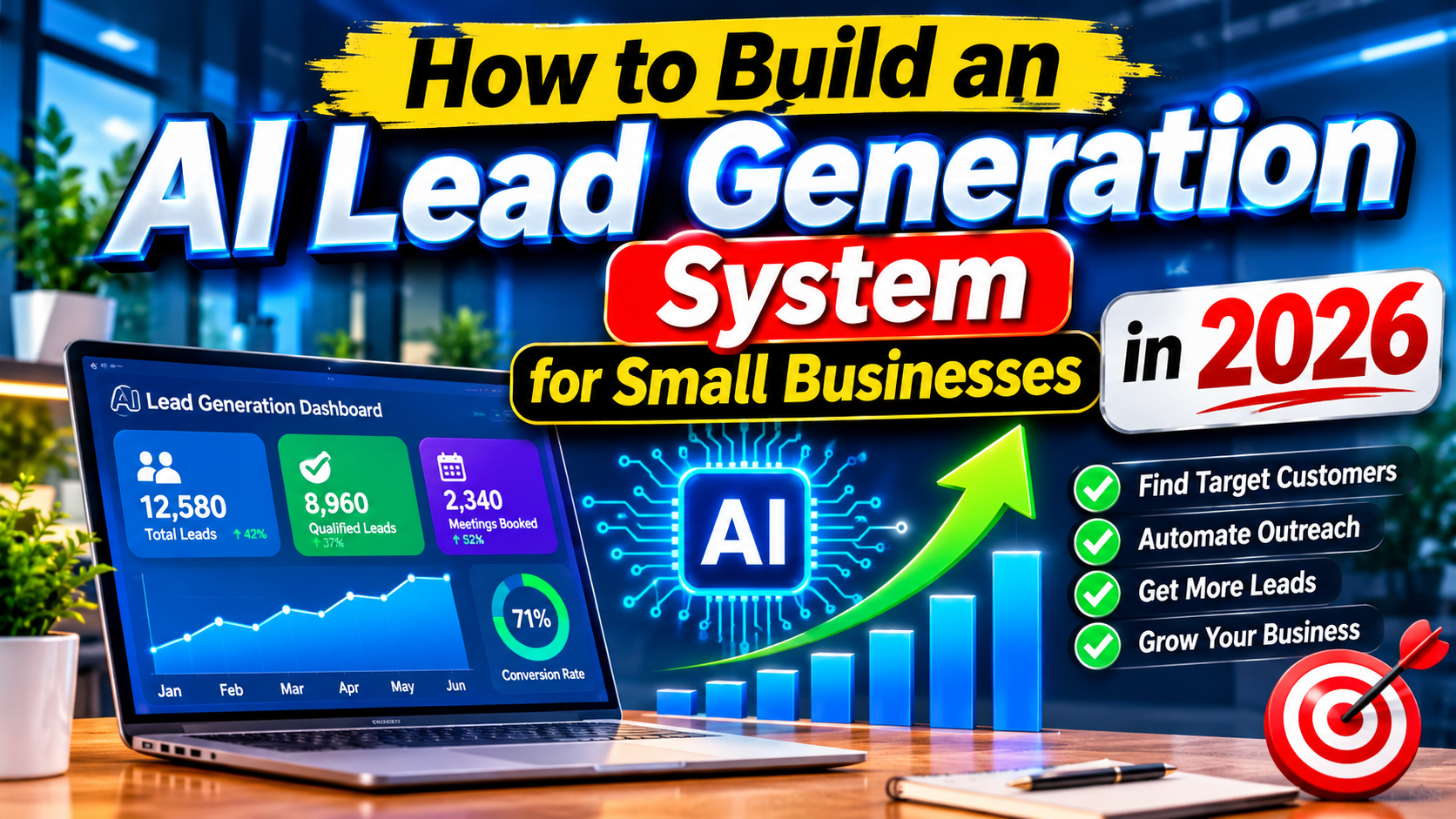
How to Build an AI Lead Generation System for Small Businesses in 2026
Finding new customers is one of the biggest challenges for small businesses, freelancers, consultants, and digital marketing agencies. Traditional lead generation often involves hours of manual research, spreadsheets, cold emails, follow-ups, and sales administration.
But artificial intelligence is changing how businesses approach customer acquisition. Building an AI Lead Generation System helps small businesses organize prospect research, identify relevant opportunities, and create a more consistent customer acquisition process.
An AI lead generation system combines artificial intelligence, business research, automation, lead qualification, personalized communication, and customer relationship management (CRM) to help businesses identify and manage potential customers more efficiently.
Instead of performing every repetitive task manually, businesses can use AI to research prospects, identify business opportunities, organize leads, prepare personalized messages, and manage follow-up activities.
In this complete guide, you will learn how to build an AI lead generation system for small businesses in 2026, step by step, even if you are starting with a limited budget.
You will also discover how to connect AI tools, Google Maps research, business websites, spreadsheets, CRM platforms, email outreach, and automation workflows into one organized client acquisition process.
How an AI Lead Generation System Works for Small Businesses
An AI Lead Generation System connects business research, prospect qualification, personalized outreach, and CRM automation into one organized workflow. Small businesses can use this approach to identify relevant prospects and manage potential customer relationships more efficiently.
Watch the complete video tutorial:
How to Build an AI Lead Generation System for Small Businesses in 2026
What Is an AI Lead Generation System?
An AI lead generation system is a process that uses artificial intelligence and automation to discover potential customers, research their businesses, evaluate their needs, and organize opportunities for sales conversations.
A traditional lead generation process may require a person to:in 2026.
- Search for potential customers.
- Visit individual business websites.
- Collect company information.
- Identify decision-makers.
- Write personalized emails.
- Track responses.
- Schedule follow-ups.
- Update customer records.
An AI-powered workflow can assist with many of these activities.
For example, a digital marketing agency offering website development and SEO services could use AI to identify local businesses with outdated websites, research their online presence, organize potential prospects, and prepare relevant service recommendations.
The important difference is that AI should support research and repetitive work rather than replace human judgment.
According to IBM’s overview of AI lead generation, AI can help businesses identify and qualify prospects using data analysis, machine learning, and predictive techniques.
Read IBM’s guide to AI for lead generation.
Why Small Businesses Need AI Lead Generation in 2026
Small businesses usually operate with limited budgets and smaller teams. They cannot always afford dedicated sales departments or large marketing teams.
AI offers an opportunity to improve existing processes without immediately increasing operational costs.
Here are some important benefits.
1. Reduce Manual Research
AI can help analyze company websites, business descriptions, services, and publicly available information.
Instead of manually reviewing every prospect, businesses can use AI to summarize relevant details and identify potential opportunities.
2. Discover Better Prospects
Finding hundreds of random business contacts does not necessarily create a successful sales pipeline.
AI-assisted research can help identify prospects based on:
- Industry.
- Business location.
- Company size.
- Services offered.
- Website quality.
- Relevant business needs.
- Potential service opportunities.
This makes the research process more focused.
3. Personalize Customer Outreach
Generic messages rarely explain why a particular business should consider your service.
AI can help create personalized communication using verified business information.
For example, instead of sending:
“Hello, we offer website development services. Are you interested?”
A more relevant message might mention a specific website issue or missing business feature and explain how improving it could help the company.
All AI-generated messages should be reviewed before sending.
4. Improve Follow-Up Management
Potential customers may not respond to the first message.
A CRM and automation workflow can help schedule reminders, track conversations, and prevent promising prospects from being forgotten.
5. Measure Sales Performance
An organized lead generation system makes it easier to track:
- Total prospects researched.
- Qualified leads.
- Outreach messages sent.
- Replies received.
- Meetings booked.
- Opportunities created.
- Customers acquired.
These metrics help businesses understand whether their lead generation process is producing meaningful results.
AWS also recommends starting AI marketing initiatives with measurable business outcomes, limited pilot projects, and appropriate human oversight.
Explore AWS AI marketing strategies for small businesses.
Step 1: Choose Your Target Market and Business Niche
Before selecting AI tools, decide which businesses you want to reach.
Trying to target every industry at once makes research, personalization, and service recommendations more difficult.
Start with one clearly defined niche.
Examples include:
- Dental clinics.
- Real estate agencies.
- Restaurants.
- Law firms.
- Accounting companies.
- Home improvement businesses.
- Plumbers and electricians.
- Fitness studios.
- Local retailers.
- Professional consultants.
For example, imagine you run a digital marketing agency that offers website development, local SEO, and Google Business Profile optimization.
You could begin by targeting independent dental clinics in a specific city.
Your research would focus on finding clinics that may benefit from better websites, stronger local search visibility, or improved online customer experiences.
Define Your Ideal Customer Profile
An Ideal Customer Profile (ICP) describes the type of business most likely to benefit from your services.
Create a simple profile containing:
| Criteria | Example |
|---|---|
| Industry | Dental clinics |
| Location | London, UK |
| Business type | Independent clinic |
| Company size | Small business |
| Website | Existing website |
| Potential need | Local SEO improvement |
| Service offered | SEO and website optimization |
| Decision-maker | Owner or practice manager |
This profile gives your AI research workflow a clear direction.
Step 2: Select the Right AI Lead Generation Tools
You do not need dozens of subscriptions to build your first system.
Start with tools that solve specific problems and work with your existing business processes.
Here are useful categories to consider.
AI Research and Writing Tools
AI assistants can help with:
- Business research.
- Prospect summaries.
- Customer profiles.
- Lead qualification criteria.
- Personalized email drafts.
- Sales proposals.
- Follow-up message preparation.
Explore ChatGPT for AI-assisted research, writing, and workflow planning.
Business Discovery Tools
Business discovery platforms and search engines can help you find companies based on industry, location, and business category.
Examples include:
- Google Maps
- Google Search
- Industry-specific business directories.
- Company websites.
- Professional business networks.
Use these sources to identify relevant businesses and verify information.
CRM and Lead Management Tools
A Customer Relationship Management system helps organize prospects and sales activities.
Examples include:
A CRM can help you maintain company records, track communication, assign lead stages, and manage follow-ups.
Automation Tools
Automation platforms connect different applications and move information between them.
Examples include:
For example, an automation could take an approved lead from a spreadsheet, create a CRM record, and generate a follow-up task.
Always check each platform’s available features, pricing, and usage limits before choosing it.
Step 3: Find Potential Customers Using Google Maps and Online Research
Once you have selected your niche, begin discovering relevant businesses.
Google Maps is especially useful for local business research.
Suppose your target market is independent restaurants in Manchester.
You can search for relevant categories and review the business listings.
Look for information such as:
- Business name.
- Website.
- Location.
- Business category.
- Public business contact details.
- Services offered.
- Customer reviews.
- Online presence.
You can also visit each business website to understand its services and customer experience.
Use AI to Organize Your Research
After collecting relevant information, provide the verified business details to an AI assistant and ask it to organize the information.
For example:
“Analyze the following business information. Summarize the company’s services, target customers, website quality, online presence, and possible opportunities for website development or local SEO. Do not invent missing information. Clearly identify anything that requires manual verification.”
This approach makes research more structured and reduces the risk of relying on unsupported assumptions.
Important: Do not treat every business listing as permission to send marketing messages. Follow applicable privacy, marketing, and platform rules when collecting and using business information.
Step 4: Build a Lead Generation Spreadsheet
Before connecting automation tools, create a structured lead database.
A spreadsheet is enough for an initial experiment.
Use these columns:
| Column | Purpose |
|---|---|
| Company Name | Identify the business |
| Website | Business website |
| Industry | Business category |
| Location | City or region |
| Public Business Email | Verified contact information |
| Phone | Public business number, where appropriate |
| Website Status | Basic website assessment |
| Business Need | Potential improvement |
| Lead Score | Priority assessment |
| Lead Status | Current sales stage |
| Next Action | Required follow-up |
| Research Date | Last verification date |
Use fictional sample records while testing your workflow.
Avoid collecting unnecessary personal information. Keep your database accurate and remove records that should no longer be retained.
Step 5: Use AI for Lead Qualification and Scoring
Not every prospect is equally valuable.
A business may fit your target industry but have no need for your services.
Lead qualification helps prioritize the most relevant opportunities.
You can create a simple scoring model.
| Qualification Factor | Example Score |
|---|---|
| Matches target industry | 20 |
| Located in target market | 15 |
| Relevant service requirement | 25 |
| Verified business website | 10 |
| Identified improvement opportunity | 20 |
| Suitable business contact channel | 10 |
| Total | 100 |
These scores are illustrative, not universal benchmarks. Adjust them according to your business model.
You can ask AI to evaluate each prospect against your criteria.
Example AI Lead Qualification Prompt
“Evaluate this business as a potential customer for our digital marketing services.
Analyze its industry, location, website, publicly available services, and potential business needs.
Assign a score from 0 to 100 using the qualification criteria I provide.
Explain the reasons for the score, identify missing information, and recommend whether this prospect should receive further research.
Never invent business details or claim that an opportunity exists without supporting evidence.”
AI can help organize the assessment, but a human should verify important findings before taking action.
Step 6: Identify Business Problems and Service Opportunities
Successful client acquisition starts with understanding a business’s needs.
Instead of approaching every prospect with the same offer, look for relevant opportunities.
For example:
Website Development Opportunities
Check whether a business has:
- An outdated website.
- Poor mobile usability.
- Missing service pages.
- Confusing navigation.
- An incomplete contact form.
- Slow-loading pages.
Local SEO Opportunities
Review:
- Local keyword targeting.
- Location-specific service pages.
- Website content quality.
- Search visibility.
- Internal linking.
- Relevant local business information.
Google Business Profile Opportunities
Review publicly visible profile information, such as:
- Business description.
- Opening hours.
- Services.
- Business photos.
- Customer review responses.
- Contact information.
Do not claim that a business has a particular problem unless you have actually verified it.
Google’s guidance on appearing in search and AI-powered experiences emphasizes useful, accessible website content and accurate business information.
Explore Google Search Central.
Step 7: Generate Personalized AI Outreach Emails
Once you have identified a relevant business opportunity, prepare a personalized message.
AI can help you draft professional emails based on verified research.
A good outreach email should contain:
- A relevant subject line.
- A personalized opening.
- A specific business observation.
- A helpful recommendation.
- A simple call to action.
- Professional contact information.
Example AI-Generated Outreach Email
Subject: A website improvement opportunity for your business
Hello,
I came across your business while researching companies in your industry.
I noticed an opportunity to improve the way your website presents your services and helps potential customers get in touch.
We help small businesses improve their websites, local search visibility, and digital customer experience.
If improving your online presence is something you’re considering, I’d be happy to share a few practical suggestions.
Would you be open to a brief conversation?
Best regards,
Your Name
Your Business
Your Website
This is an example template. Personalize it using genuine research and avoid pretending that you have conducted an audit if you have not.
Example AI Email Personalization Prompt
“Write a short professional outreach email for this business using only the verified information provided.
Mention one relevant business observation, explain how our service could help, and include a polite call to action.
Avoid exaggerated claims, fake compliments, guaranteed results, and generic sales language.
Keep the message natural, respectful, and easy to understand.”
For more guidance, explore HubSpot’s AI email personalization strategies.
Step 8: Prepare Personalized WhatsApp Business Messages
For businesses where WhatsApp is an appropriate communication channel, AI can help prepare concise and professional messages.
Example:
Hello! I came across your business while researching local companies in your industry.
I noticed a possible opportunity to improve your online visibility and website experience.
We help businesses with website development and local SEO. Would you be interested in receiving a few practical suggestions?
Keep WhatsApp outreach respectful.
Only use appropriate contact channels, follow applicable marketing rules, and respect requests not to receive further messages.
Do not use automation to send unsolicited bulk messages or repeatedly contact people who have declined.
Step 9: Create Professional Business Proposals with AI
When a prospect shows genuine interest, the next step is to prepare a relevant proposal.
AI can help organize the proposal into clear sections.
A professional proposal should include:
- Business overview.
- Identified challenges.
- Recommended services.
- Project scope.
- Deliverables.
- Estimated timeline.
- Pricing.
- Terms and conditions.
- Next steps.
For example, a local restaurant may need a mobile-friendly website, local SEO improvements, and a better online inquiry process.
Instead of offering every available service, prepare a proposal that focuses on the business’s actual requirements.
This makes the offer easier to understand and evaluate.
Step 10: Connect Your Lead Generation System to a CRM
A CRM is an important part of an organized AI lead generation process.
It helps you maintain a record of each prospect and track the progress of business conversations.
Create these pipeline stages:
- New Lead
- Researching
- Qualified
- Contacted
- Replied
- Interested
- Meeting Scheduled
- Proposal Sent
- Won
- Lost
Each lead should have an owner, status, relevant notes, and next action.
When a prospect replies, update the CRM.
When a meeting is scheduled, record the date.
When a prospect declines, update the status and stop inappropriate follow-up activity.
This prevents confusion and helps small teams manage their sales pipeline more effectively.
Step 11: Build an AI Lead Generation Automation Workflow
Now connect the main parts of your system.
A practical workflow can look like this:
Business Discovery → Research → Qualification → Human Review → Personalized Outreach → Response Tracking → CRM Update → Follow-up → Sales Meeting
Here is how each stage works.
Stage 1: Lead Discovery
Find relevant businesses through search engines, directories, and suitable business discovery platforms.
Stage 2: Business Research
Collect verified business information and analyze potential service opportunities.
Stage 3: AI Qualification
Evaluate the prospect against your ideal customer profile and assign a priority score.
Stage 4: Human Approval
Review the business information, qualification decision, and proposed message.
Stage 5: Personalized Outreach
Prepare an appropriate email or other permitted business communication.
Stage 6: Response Tracking
Record replies and identify prospects who have shown genuine interest.
Stage 7: CRM Updates
Update the prospect’s status and create relevant tasks.
Stage 8: Follow-up Management
Schedule appropriate follow-ups and automatically suppress contacts who opt out or decline.
Stage 9: Sales Conversion
Arrange consultations, prepare proposals, and manage the customer relationship.
Automation should make the workflow more organized, not remove the human review needed for important business decisions.
You can use Make or Zapier to connect supported applications and build workflows.
For additional ideas, read our guide to AI Agents for Small Businesses in 2026. For the marketing side of a system like this, start with these AI marketing workflows.
Step 12: Schedule Follow-ups Without Spamming Prospects
Many sales opportunities require more than one conversation.
However, excessive follow-up messages can damage your business reputation.
Create a reasonable communication schedule based on the prospect’s preferences, applicable laws, and previous engagement.
For example:
| Activity | Suggested Action |
|---|---|
| Initial Contact | Send a relevant introduction |
| First Follow-up | Check whether the message was received |
| Second Follow-up | Offer a useful additional insight |
| Final Contact | Politely close the conversation |
| No Further Contact | Respect non-response or opt-out rules |
The timing should be adjusted for your industry and communication channel.
Stop follow-up messages when a prospect declines or requests no further contact.
HubSpot’s guidance on automated prospecting also highlights the importance of accurate CRM data, frequency controls, and automatic opt-out handling.
Read HubSpot’s automated prospecting guide.
Step 13: Track Your AI Lead Generation Performance
An AI lead generation system should be measured using meaningful business outcomes.
Do not judge success only by the number of leads collected.
Track the complete journey from prospect discovery to customer acquisition.
Important metrics include:
Total Leads
How many relevant businesses have been researched?
Qualified Lead Rate
What percentage of researched businesses meet your qualification criteria?
Formula:
Qualified Lead Rate = (Qualified Leads ÷ Total Leads) × 100
Outreach Reply Rate
What percentage of delivered outreach messages receive a response?
Formula:
Reply Rate = (Replies ÷ Delivered Messages) × 100
Meeting Conversion Rate
What percentage of qualified prospects book a meeting?
Formula:
Meeting Conversion Rate = (Meetings Booked ÷ Qualified Leads) × 100
Customer Conversion Rate
What percentage of qualified leads become paying customers?
Formula:
Customer Conversion Rate = (New Customers ÷ Qualified Leads) × 100
Cost Per Acquired Customer
How much does your business spend to acquire each new customer?
Formula:
Customer Acquisition Cost = Total Acquisition Costs ÷ New Customers
Review these numbers regularly to understand which channels and processes are working.
Step 14: Improve Your System Using AI Insights
Your first automation workflow will not necessarily be your best workflow.
Review performance regularly and improve one area at a time.
For example:
- If too many prospects are irrelevant, improve your target audience criteria.
- If business research contains errors, strengthen data verification.
- If messages sound generic, improve personalization instructions.
- If prospects are not responding, review the offer and communication quality.
- If interested prospects are being forgotten, improve CRM reminders.
- If customer acquisition costs are high, review the entire sales process.
Start with one measurable improvement rather than automating everything simultaneously.
AWS recommends testing focused AI use cases, establishing performance baselines, and expanding only after the results are measurable.
A Simple 7-Day AI Lead Generation Implementation Plan
You do not need to build the entire system in one day.
Use this practical seven-day starting plan.
| Day | Task | Expected Output |
|---|---|---|
| Day 1 | Select one niche and target market | Ideal customer profile |
| Day 2 | Choose AI and research tools | Basic tool setup |
| Day 3 | Research potential businesses | Initial prospect database |
| Day 4 | Qualify leads and identify opportunities | Prioritized lead list |
| Day 5 | Prepare personalized outreach | Reviewed message templates |
| Day 6 | Connect CRM and follow-up workflows | Organized sales pipeline |
| Day 7 | Review performance and improve | First system evaluation |
This is a suggested implementation schedule, not a guarantee of customers or revenue within seven days.
Common AI Lead Generation Mistakes to Avoid
Even a well-designed AI workflow can fail if the underlying process is poor.
Avoid these common mistakes.
1. Targeting Every Industry
A broad audience makes personalization difficult. Start with a clearly defined niche.
2. Collecting Too Much Unnecessary Data
Only collect information that is relevant to your business purpose and that you are permitted to use.
3. Trusting Every AI Output
AI can generate incorrect business details, outdated information, and unsupported assumptions. Verify important information before using it.
4. Sending Generic Bulk Messages
Large volumes of irrelevant messages do not create meaningful customer relationships.
5. Ignoring Customer Preferences
Respect unsubscribe requests, communication preferences, and applicable privacy requirements.
6. Automating Without Human Approval
Keep human review for prospect qualification, important business claims, and customer-facing communication.
7. Measuring Only Lead Volume
A large database is not necessarily a successful sales pipeline. Focus on qualified prospects, meaningful replies, meetings, and actual customers.
AI Lead Generation and Data Privacy: What Businesses Should Know
Responsible data handling is essential when building an automated lead generation system.
Before collecting or processing business and contact information:
- Understand the privacy and marketing laws applicable to your location and target market.
- Use appropriate and lawful data sources.
- Collect only relevant information.
- Keep business records accurate.
- Protect stored contact information.
- Respect consent and communication preferences where required.
- Provide appropriate unsubscribe options.
- Maintain suppression lists for people who opt out.
- Avoid misleading messages and false personalization.
- Review the terms of the platforms you use.
Businesses targeting customers in the UK or European Union should pay particular attention to applicable data protection and electronic marketing rules.
Useful official resources:
- UK Information Commissioner’s Office – Direct Marketing Guidance
- European Commission – Data Protection
- US Federal Trade Commission – CAN-SPAM Act
This article provides general educational information, not legal advice. Check the requirements that apply to your specific business and outreach activities.
Frequently Asked Questions About AI Lead Generation
What is the best AI lead generation system for small businesses?
The best system depends on your target market, budget, services, and existing tools. A practical starting setup combines an AI assistant, business research, a spreadsheet or CRM, personalized outreach, and follow-up reminders.
Can AI generate leads automatically?
AI can assist with business discovery, research, lead qualification, data organization, and outreach preparation. However, businesses should verify information, review messages, and maintain appropriate human oversight.
How do I find local business leads using AI?
Start with a specific industry and location. Use Google Maps, search engines, business directories, and company websites to discover relevant businesses. Then use AI to organize verified information and identify potential service opportunities.
Can ChatGPT help with lead generation?
Yes. ChatGPT can help define ideal customer profiles, research businesses using information you provide, evaluate prospects against criteria, draft personalized outreach, prepare proposals, and organize sales workflows.
Is AI lead generation free?
You can start with free or limited-use AI tools, spreadsheets, search engines, and basic CRM plans. Some advanced research, enrichment, automation, and outreach features require paid subscriptions.
What is the difference between AI lead generation and traditional lead generation?
Traditional lead generation often relies on manual prospect research, qualification, communication, and tracking. AI-assisted lead generation uses artificial intelligence and automation to support these activities, improve organization, and reduce repetitive work.
Can a beginner build an AI lead generation system?
Yes. Beginners can start with one niche, an AI assistant, a spreadsheet, and a simple CRM. They can gradually introduce automation as their process becomes more organized.
Does AI lead generation guarantee customers?
No. AI can improve research and workflow efficiency, but it cannot guarantee replies, meetings, sales, or income. Results depend on the business offer, market demand, prospect quality, communication, and sales execution.
Final Thoughts: Build a Smarter Client Acquisition System with AI
AI lead generation is not simply about collecting more business contacts or sending more automated emails.
It is about building a repeatable process that helps your business discover relevant prospects, understand their needs, communicate professionally, and manage customer relationships.
Start with one industry, define your ideal customer, research genuine business opportunities, and organize your prospects in a CRM.
Then introduce AI-assisted qualification, personalized outreach, and carefully controlled automation.
Improve the process using real performance data rather than relying on assumptions.
If you want to explore more practical AI tools, business automation tutorials, and digital skills, visit EarnLabWithAI.com.
Explore our related guides:
- AI Agents for Small Businesses in 2026
- AI Income System 2026: A Beginner’s Guide
- Explore Free AI Tools and Resources
EarnLabWithAI — Learn AI. Build Skills. Grow Digitally.
Quick Checklist: Your AI Lead Generation System
Use this checklist to launch your system in seven days:
- Choose one niche and define your ideal customer profile.
- Pick your AI research, CRM and automation tools.
- Find prospects with Google Maps, search and business directories.
- Record verified business details in a spreadsheet or CRM.
- Score and qualify each lead before you contact them.
- Write one personalised outreach message based on verified research.
- Have a human review every message before it is sent.
- Track replies, meetings and customers, not just lead volume.
- Follow up politely and stop when a prospect declines or opts out.
- Review your results weekly and improve one step at a time.